From Instrumentalists to Conductors
How software engineering is shifting from execution to direction - and why the best engineers now look more like conductors than soloists.
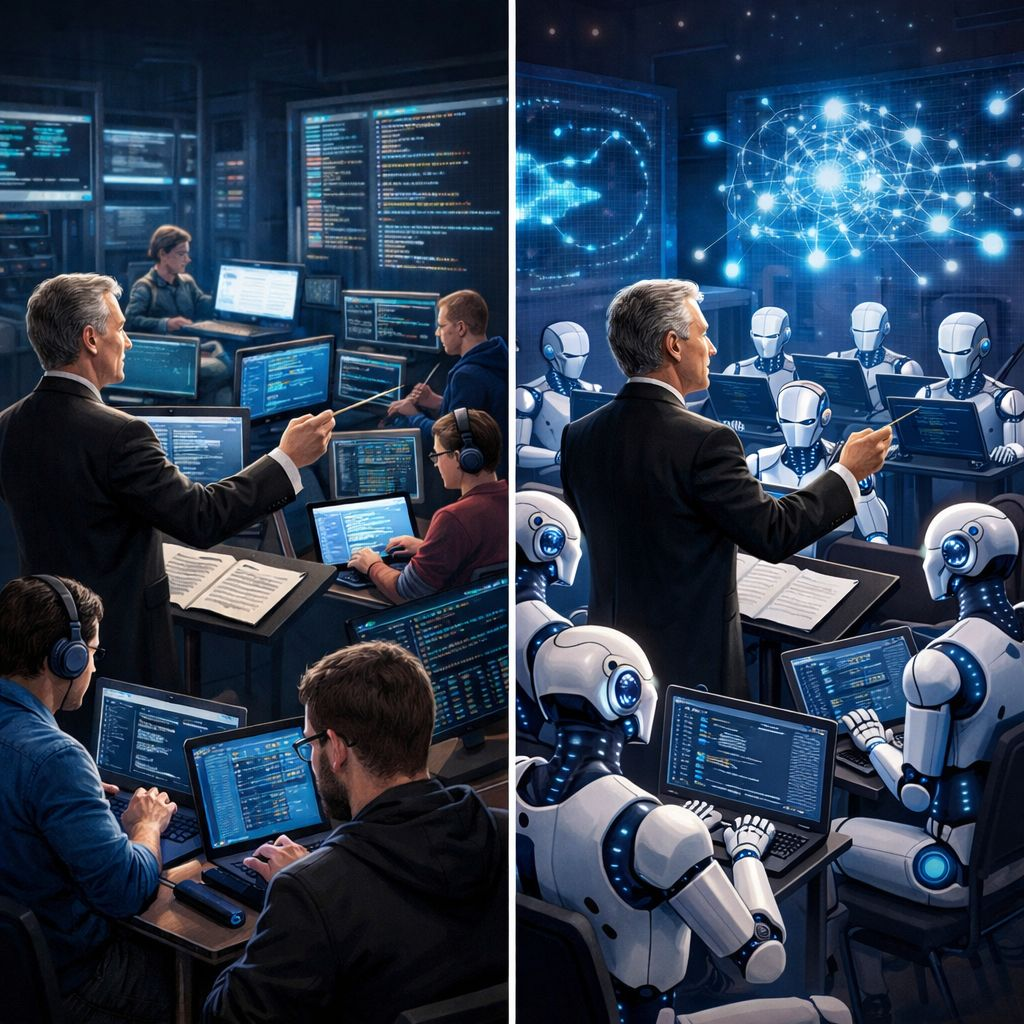
There's a version of the AI conversation that goes: "will it take our jobs?" That question is less interesting than the one underneath it - how does the job itself change when the tools get this capable?
For software engineers, the answer is already visible if you're paying attention.
The instrumentalist model
For most of computing history, the best engineer in the room was the one who could produce the most output with their hands. Speed of typing, depth of syntax recall, ability to hold a complex system in working memory. These things mattered because the bottleneck was execution. Someone had to write every line.
That model still has value. It's just no longer where the ceiling is.
A good musician who plays an instrument well can produce something beautiful. But a conductor with a 60-piece orchestra produces something no single instrumentalist can, regardless of how technically gifted they are. The conductor's job isn't to play faster. It's to coordinate intelligence that already exists, shape it toward a coherent outcome, and know when each section should come in.
This is where software engineering is going.
What's actually changing
The engineers getting the most done right now aren't the fastest typists. They're the ones who can decompose a problem clearly, delegate pieces of it to AI systems, review and direct the output, and integrate the results into something coherent. Intercom now has 95.9% of its pull requests authored by Claude. Airbnb engineers using AI four or more hours a day are doubling their output versus pre-AI baselines. The throughput gains aren't coming from people who resisted the tools and coded harder.
The skill set that produces these results is different from the one that made someone a strong engineer five years ago. Knowing how to prompt a model precisely. Knowing when to trust the output and when to be suspicious of it. Knowing how to structure a problem so an agent can work on it in parallel rather than sequentially. Knowing which model is appropriate for which task. These are conducting skills, applied to software.
The engineers who are struggling with the transition are often technically strong people who learned that being good meant being the one who could do it themselves. That instinct becomes a liability when the leverage is in direction, not execution.
This isn't only about software
Radiology has the same dynamic. The radiologist who uses AI to process scan volume and flags the anomalies that need human judgment sees more patients and catches more. The one who competes with AI on read speed loses.
In law, the associates generating the first drafts of contracts and memos are being outpaced by partners who understand what a good brief looks like and can direct an AI to produce fifty of them in a morning. The legal skill that matters is judgment about quality and risk, not the ability to type faster than a model.
Fund managers, architects, journalists, teachers - in each case, the people maintaining relevance are the ones who shifted from producing output to directing it. The underlying knowledge didn't become less important. It became more important, because now you need it to evaluate output rather than generate it.
The conductor doesn't need to play the violin. But they need to know, immediately, when the violinist is off.
What this means for how you develop as an engineer
The skills worth building now aren't the ones that make you faster at what AI already does well. They're the ones that sit above execution: system design, problem decomposition, technical judgment, the ability to evaluate code you didn't write for correctness and risk.
You also need fluency with the tools themselves. Using Claude occasionally for autocomplete is the equivalent of a conductor who only knows how to tap the podium. The engineers who are pulling away from their peers right now use these systems deeply, daily, on hard problems, not just for boilerplate.
The instrumentalists who become conductors will run engineering teams, shape products, and build things that weren't possible before. The ones who don't make the shift will find themselves in the same position as someone who spent years perfecting their cursive handwriting around the time word processors arrived. The craft was real. The market for it changed anyway.
The good news is that this transition rewards people who are genuinely curious about how systems work, who care about outcomes more than credit, and who are willing to direct intelligence rather than hoard it. Those people have always been the best engineers. Now the tools finally match the way they think.